Babys and Ear Tube Surgery
2009-10-11 08:56This article ia about ear tube surgery for babys.
It's a terrible thing as a parent to have something wrong with your child that no one can fix. When the word surgery is used, it can be even more terrifying. For Sherri Chamness, a homeschooling mom from Turner, Ore., it was twice as terrifying knowing that the ear infections that had brought them to this point were having a permanent effect on her daughter's hearing.
"My daughter has had more infections than you can count," says Chamness. "I don't remember the names of all the drugs used. At one point, they told me that we could no longer use Penicillin, because her body was too use to it and had no effect on the infections." Chamness says the hardest part for her was knowing that there was no answer. "I wanted my daughter well, and no one could do that," she says.
Like many other parents, Chamness was faced with the option of continuing to battle with ear infections, which could lead to more hearing loss or getting tubes put in her daughter's ears.
Dr. James Thomsen, from Children's Healthcare of Atlanta, says in order to get to this point, your child must be diagnosed with chronic ear infections. "Some ear infections get better on their own, and some must be treated with antibiotics," he says. "However, if your child has recurring ear infections, such as more than six infections in six months, it may be necessary to place a tube in the ear."
Often times, it isn't six different ear infections, but the same one that refuses to completely clear up. Ear tubes are used to break this cycle, allowing the ears to completely drain and ventilate. The drainage removes any fluid in the middle ear, and the ventilation allows the lining of the middle ear to return to normal. "The tubes usually stay in for about a year," says Dr. Thomsen. "After that, they come out by themselves."
Ear tube surgery is a surgical procedure in which a small incision is made in the eardrum (the tympanic membrane), usually in both ears. The word comes from myringa, modern Latin for drum membrane, and tome, Greek for cutting. It is also called myringocentesis, tympanotomy, tympanostomy, or paracentesis of the tympanic membrane. Fluid in the middle ear can be sucked out through the incision.
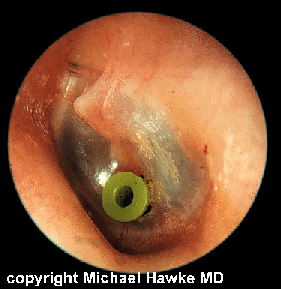
Ear tubes, or tympanostomy tubes, are small tubes, open at both ends, that are inserted into the incisions in the eardrums during myringotomy. They come in various shapes and sizes and are made of plastic, metal, or both. They are left in place until they fall out by themselves or until they are removed by a doctor.
The surgical procedure for placing tubes in the ears has become one of the most commonly performed operations of any kind, perhaps, in part, because the procedure is so simple and so effective. The surgeon can reach the eardrum through the ear opening, which means there is no need to cut the skin.
A tiny tube, made of either plastic or metal and with a collar on both ends, is slipped through a tiny incision in the eardrum. This is done in an area that will not affect hearing. This pressure-equalization tube provides a temporary, extra Eustachian tube to allow bacteria and fluid to drain from the middle ear. The procedure has been in widespread use since 1954.
Adults who need ear tubes can usually get away with a local anesthetic. Because the surgery is so precise, the patient must be very still during the operation. For children, the operation is best performed in an operating room with a light general anesthetic. The procedure is generally safe, though there are risks associated with administration of the anesthetic. However, all patients are monitored closely during the procedure.
The surgery itself usually takes about five minutes, and you can take your child home within a few hours. They are usually only asleep for a total of 15 minutes. Some children feel minimal discomfort afterward and are relieved by acetaminophen, while others require a more powerful pain reliever such as codeine.
Once home, make sure your child gets plenty of liquids, such as juice, gelatin, soups, etc. Your child can then go on his regular diet in the morning after surgery. Have your child rest and take it easy for the first 24 hours after surgery. After that, he should be able to return to his regular schedule should he feel up to it.
If any of the following problems occur, you should immediately call your child's otolaryngologist or pediatrician:
- Ear pain that is not eliminated by giving the child non-aspirin pain reliever.
- Bright red bleeding coming from inside the ear.
- Trouble hearing.
- A temperature higher than 101.5 degrees F. (It is normal after surgery for your child to have a low-grade fever.)
- A bad smell or pus oozing from the ears.
After-surgery care includes making sure that water doesn't enter the ear canal. Ear tubes help prevent recurring ear infections by allowing air to ventilate the middle ear. But water can also enter the tubes, carrying bacteria and viruses, which can re-infect your child's ears. Always plug your child's ears during any water activity, such as swimming, bathing, showering, etc. Your pediatrician can provide you with information about earplugs and custom-made ear molds.
Dr. Mark A. Richardson, chair of department of otolaryngology for the Oregon Health and Science University, says that complications are infrequent, though it may cause problems when the tube is due to come out. "It can leave a hole in the eardrum after it comes out," he says. "It may also leave a scar in the eardrum after it extrudes the way it's supposed to and the eardrum heals."
Ear tube surgery risks
The risks include:
-
Cutting the outer ear
-
Formation at the myringotomy site of granular nodes due to inflammation
-
Formation of a mass of skin cells and cholesterol in the middle ear that can grow and damage surrounding bone (cholesteatoma)
-
Permanent perforation of the eardrum.
The risk of persistent discharge from the ear (otorrhea) is 13%.
If the procedure is repeated, structural changes in the eardrum can occur, such as loss of tone (flaccidity), shrinkage or retraction, or hardening of a spot on the eardrum (typmanosclerosis). The risk of hardening is 51%; its effects on hearing are not known, but they are probably insignificant.
It is possible that the incision will not heal properly, leaving a permanent hole in the eardrum, which can cause some hearing loss and increases the risk of infection.
It is also possible that the ear tube will move inward and get trapped in the middle ear, rather than move out into the external ear, where it either falls out on its own or can be retrieved by a doctor. The exact incidence of tubes moving inward is not known, but it could increase the risk of further episodes of middle-ear inflammation, inflammation of the eardrum or the part of the skull directly behind the ear, formation of a mass in the middle ear, or infection due to the presence of a foreign body.
The surgery may not be a permanent cure. As many as 30% of children undergoing myringotomy with insertion of ear tubes need to undergo another procedure within five years.
The other risks include those associated with sedatives or general anesthesia.
Using the EARDOC can prevent Myringotomy surgery
Alternative to Ear Tube Surgery (Myringotomy)
———
Back